
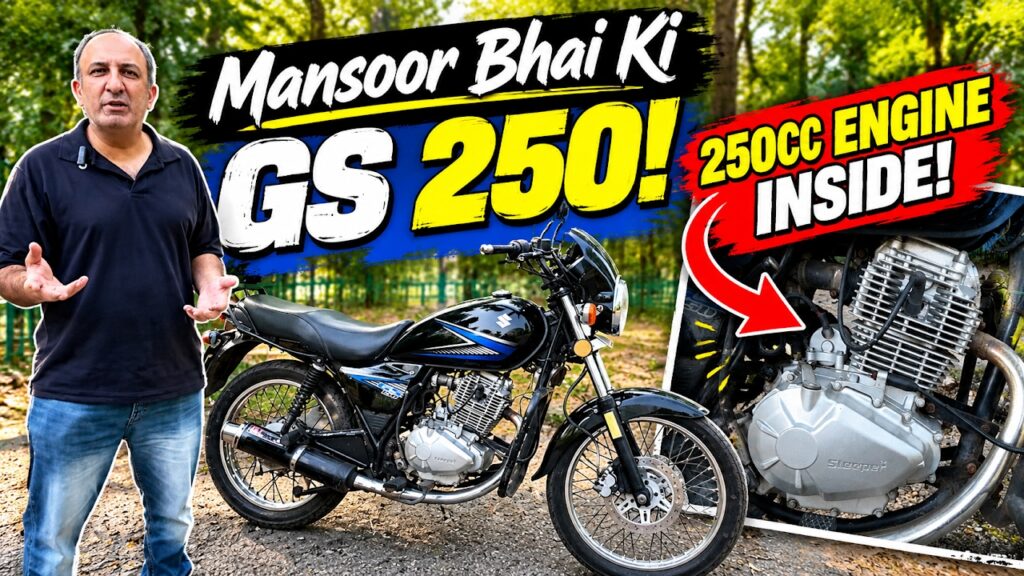
At first glance, this motorcycle looks like an ordinary Suzuki GS150. It has a classic appearance, a top box, a simple exhaust setup, and what many would call an uncle-style modification. But looks can be deceiving!
This isn’t a stock Suzuki GS150. Hidden inside its familiar frame is a more powerful Chinese engine, turning an otherwise ordinary commuter into a unique sleeper motorcycle.
We recently met Mansoor Bhai, a long-time motorcycle enthusiast, to learn about his unusual GS150 build, the engine swap, its running costs, fuel economy, and whether such a project is worth undertaking in Pakistan.
The Story Behind the Engine Swap
Mansoor Bhai owns a 2014 Suzuki GS150. Like many experienced riders, he eventually wanted something more exciting than the standard motorcycle could offer.
While the stock GS150 remains a practical and capable motorcycle for everyday use and touring, Mansoor Bhai wanted to do something different. Instead of restoring an old engine or trying to extract more power from the original unit, he began researching the possibility of installing a more powerful Chinese engine.
The idea wasn’t entirely new. He had been following the work of other enthusiasts and was particularly interested in an engine that could be fitted into the GS150 frame with manageable modifications.
An opportunity eventually came through Waqar Bhai, a well-known motorcycle enthusiast who had been experimenting with Chinese engines for several years. When the engine Mansoor Bhai had been following became available, he decided to go ahead with the project.
The result is a motorcycle that has now covered approximately 13,000–14,000 kilometres with the swapped engine.
The project took time, and the engine itself reportedly sat unused for around seven to eight months during the process. Altogether, the build has been part of Mansoor Bhai’s motorcycle journey for approximately three to four years.
A Sleeper Build That Doesn’t Look Modified
One of the most interesting aspects of this GS150 is its appearance.
Many modified motorcycles immediately reveal their intentions through oversized exhausts, aggressive bodywork, aftermarket fairings, or extensive cosmetic changes. Mansoor Bhai took a different approach.
His objective was to retain the classic GS150 appearance while improving performance.
The motorcycle still looks like a relatively ordinary GS150, complete with its rounded indicators, practical top box, and understated styling. Unless you know what to look for, the engine swap isn’t immediately obvious.
This is precisely what makes it a sleeper build: its performance-oriented modification remains largely hidden behind a familiar exterior.
How Was the Engine Fitted Into the GS150 Frame?
An engine swap is rarely as simple as removing one engine and installing another. Mounting points, alignment, clearances, and the surrounding components all need attention.
According to Mansoor Bhai, the original GS150 engine mounts were not used directly for the new engine. Additional mounting points had to be fabricated at both the front and rear.
However, he made a deliberate effort to preserve the original frame rather than cutting it apart. The new mounts were designed around the existing structure.
This is an important detail because the modification is reversible. If Mansoor Bhai ever wants to return the motorcycle to its original engine configuration, the swapped engine can be removed and the original setup can be restored.
For owners considering similar projects, preserving the original frame can be a significant advantage, although any engine swap should be assessed for safe mounting, alignment, handling, and structural integrity.
Engine Performance and Gearbox
The swapped engine is described as producing approximately 18–19 horsepower. This gives the motorcycle a substantial performance-oriented upgrade compared with the original GS150 configuration.
The engine also features a balancer, which Mansoor Bhai says helps keep vibrations reasonably similar to what he experiences on a standard GS150.
Naturally, this is still a single-cylinder motorcycle. It won’t produce the sound of a multi-cylinder engine, nor should anyone expect it to.
The engine is paired with a six-speed gearbox, while the motorcycle retains the GS150’s original sprocket setup.
Keeping the existing gearing means Mansoor Bhai hasn’t attempted to extract every last bit of performance from the engine. Instead, the setup reflects a balance between usable power, cruising, and fuel economy.
Note: The engine’s exact manufacturer, displacement, and independently verified power output were not established in the interview. The 18–19 HP figure is the owner’s estimate.
Carburettor and Exhaust Setup
The motorcycle uses a 30mm butterfly-type carburettor, which Mansoor Bhai describes as being related to the larger carburettor design used on the YBR family.
The exhaust setup is equally understated. Rather than installing an excessively loud aftermarket exhaust, he uses a Road Prince WEGO exhaust that he already had available.
This approach fits the overall philosophy of the build: improve the motorcycle’s performance without making it unnecessarily flashy.
Front Disc Brake Conversion: A Modification from 2016
Interestingly, the engine swap wasn’t the first major modification Mansoor Bhai made to this GS150.
Back in 2016, after completing a couple of tours, he felt that the motorcycle’s original braking performance needed improvement.
At the time, inexpensive aftermarket components were common, but he wanted a more complete solution. He therefore installed a complete Honda Deluxe front assembly, rather than assembling a braking setup from unrelated parts.
The conversion reportedly cost approximately PKR 22,000 in 2016.
This modification demonstrates that the motorcycle’s evolution took place over several years. The braking upgrade came first, followed later by the engine swap.
Fuel Economy: Is the Bigger Engine Still Economical?
One of the most surprising claims about this build concerns fuel consumption.
According to Mansoor Bhai, the motorcycle returns approximately:
- 27–28 km/l in city riding
- Over 40 km/l on longer rides, according to his estimate
He compares its consumption with that of friends riding standard GS150 motorcycles on similar routes.
However, these figures are based on his riding experience and comparison with other motorcycles, rather than a documented fuel-to-fuel test.
Several factors may help explain the reported economy. The GS150 retains its original sprocket setup, and Mansoor Bhai generally rides at a relaxed pace. He also explains that when cruising alongside friends, the standard GS150 motorcycles may be running at higher engine RPM than his swapped-engine setup.
The result, in his experience, is a motorcycle that offers additional performance without necessarily bringing a dramatic increase in fuel consumption.
Actual economy will depend on engine tuning, riding style, road conditions, gearing, and maintenance.
What Did the Complete Build Cost?
The cost of the project is particularly interesting when viewed in the context of Pakistan’s motorcycle market.
Mansoor Bhai purchased the 2014 GS150 for approximately PKR 134,500.
The major expenses he mentioned were:
| Item | Approximate cost |
|---|---|
| Suzuki GS150 (2014) | PKR 134,500 |
| Honda Deluxe front disc conversion (2016) | PKR 22,000 |
| Chinese engine swap | PKR 142,000 |
| Total of these stated costs | PKR 298,500 |
The WEGO exhaust was a gift, so Mansoor Bhai did not include it as a project expense. The table also excludes any other costs that weren’t specified during the interview.
Based on these figures, the motorcycle’s purchase price and two major modifications alone amount to approximately PKR 298,500.
That’s an interesting proposition in a market where capable new motorcycles in the 250cc category can cost considerably more. However, this comparison doesn’t account for all ownership expenses, the availability of replacement parts, registration requirements, or the value of the time and effort invested in the project.
The other important point is that Mansoor Bhai spread the expenses over several years instead of investing the entire amount at once.
Does the Engine Swap Increase Vibrations?
The GS150 is often appreciated for its relatively comfortable ride, but vibrations are an important consideration when changing an engine.
Mansoor Bhai says the swapped engine feels reasonably similar to the original GS150 in this respect. He attributes part of this behaviour to the engine’s balancer.
That doesn’t mean the motorcycle is vibration-free. Instead, his experience suggests that the change has not transformed the bike into an uncomfortable machine.
This is a useful reminder that engine swaps should be evaluated on more than horsepower alone. Engine mounting, balancing, drivetrain compatibility, and overall tuning can all affect the final riding experience.
Why Keep the Original GS150 Gearing?
Although the motorcycle now has a more powerful engine, Mansoor Bhai has retained the original GS150 sprocket arrangement.
This choice reflects his preference for a practical riding experience rather than chasing maximum acceleration or top speed.
He rides with friends who use standard GS150 motorcycles and generally maintains a relaxed cruising pace. As a result, he doesn’t feel the need to make further gearing changes.
The setup also gives the motorcycle a familiar character, preserving some of the qualities that made the original GS150 popular among touring riders.
Is a GS150 Engine Swap Worth It?
This is the question many enthusiasts will ask after seeing the build.
The answer depends on what the owner wants from a motorcycle.
For someone who enjoys engineering, customisation, and creating something different from what is available in showrooms, a sleeper build like this can be a rewarding project.
Mansoor Bhai’s motorcycle demonstrates how a familiar platform can be modified while retaining its understated appearance. It also shows the value of planning a project carefully, preserving the original frame, and spreading expenses over time.
However, an engine swap isn’t automatically cheaper or better than buying a factory-built motorcycle. Compatibility, safe fabrication, reliable tuning, spare-parts availability, and legal requirements all need to be considered.
Anyone attempting a similar conversion should have the work carried out by a competent mechanic and verify the applicable registration and engine-number requirements before riding on public roads.
Final Thoughts
Mansoor Bhai’s Suzuki GS150 is a reminder that an interesting motorcycle doesn’t always need aggressive styling, expensive accessories, or an obvious performance makeover.
From the outside, it remains a simple, classic GS150. Underneath, it features a different engine, custom mounting points, and a series of carefully considered modifications developed over several years.
What makes the project interesting isn’t just the claimed 18–19 horsepower. It’s the philosophy behind it: keep the motorcycle looking ordinary, make it more capable, and retain as much of its original character as possible.
For enthusiasts who appreciate understated builds, the result is a fascinating example of what can be achieved when creativity meets practical motorcycle engineering.


