
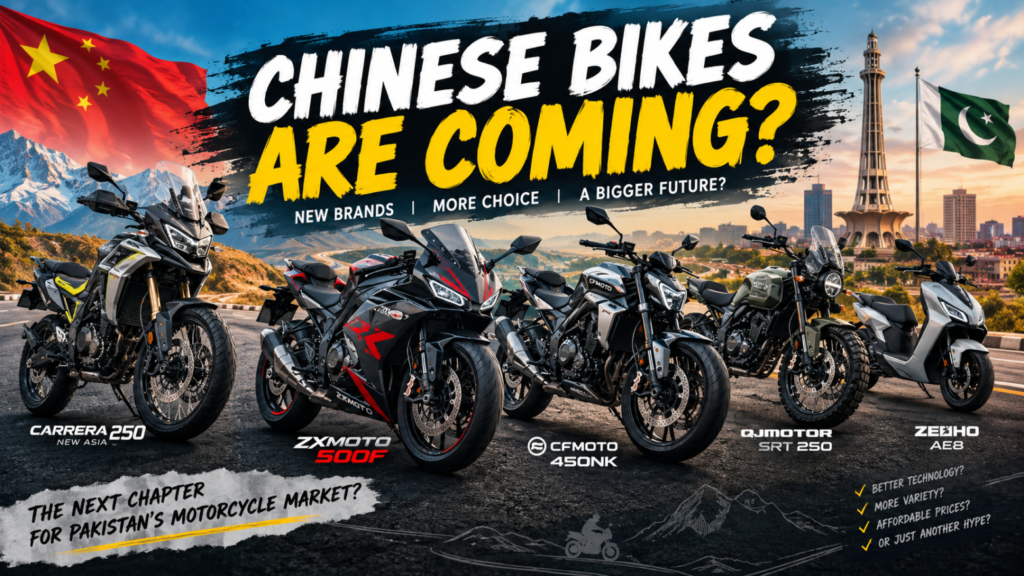
For years, Pakistan’s motorcycle market has been stuck in a strange situation.Chinese Motorcycles have always been in question due to various reasons.We have millions of motorcycles on the road. We have hundreds of thousands of new buyers every year. We have riders who want better technology, better styling, bigger engines, and completely different kinds of motorcycles.
And yet, walk into a motorcycle showroom and ask:
“What do you have apart from a 70, 100, 125, or 150?”
Suddenly, the choices become very limited.
A few years ago, this might not have bothered the average Pakistani buyer. A motorcycle was primarily transportation. It had to be cheap, economical, easy to repair, and capable of surviving Pakistani roads.
But the Pakistani motorcycle buyer is changing.
Today, there is a growing group of riders who don’t simply want a motorcycle.
They want an ADV.
They want a naked bike.
They want a proper sports bike.
They want a retro motorcycle.
They want 250cc, 300cc, 400cc, and even 500cc motorcycles.
They want ABS.
They want liquid cooling.
They want fuel injection.
They want better suspension.
They want modern designs.
And increasingly, they want motorcycles that actually feel like machines from 2026—rather than motorcycles that have evolved very slowly from designs introduced decades ago.
And this is exactly where China becomes interesting.
The Chinese Car Revolution Is Already Here
Look at what has happened in Pakistan’s automobile industry.
Chinese manufacturers have gone from being relatively unfamiliar names to becoming serious players in the passenger-car conversation.
Brands such as BYD and other Chinese manufacturers have started changing the way Pakistani consumers think about what a modern vehicle can offer.
And that transformation creates an obvious question:
If Chinese cars can come here, why can’t Chinese motorcycles?
The answer is
They can.
In fact, they already are.
The difference is that the motorcycle story is happening in smaller pieces.
Pakistan has already seen Chinese motorcycle technology enter the market through local assembly, EVs, new brands and higher-capacity motorcycles.
In 2026, for example, Thailand’s GPX officially entered Pakistan through Royal Power Group with motorcycles ranging from 125cc to 250cc, while its lineup also included electric scooters.
And ZXMOTO has announced its entry into Pakistan through a collaboration involving New Asia and Capital Motors, with motorcycles including the Sports 500RR, Naked 500F, 820R, and off-road models.
So the door isn’t closed.
If anything, the door has already started opening.
But Why Does Pakistan Still Feel Like a “Dry” Motorcycle Market?
This is probably the most interesting part.
Because if you look at the number of motorcycles sold in Pakistan, you might think we have one of the world’s most exciting motorcycle markets.
We don’t.
At least not in terms of variety.
The volume is enormous.
The variety is not.
According to PAMA data, Honda alone sold more than 1.22 million motorcycles between July 2025 and March 2026. Suzuki sold around 25,900 during the same period, while Yamaha’s sales had fallen dramatically.
This tells us something important.
Pakistan has a huge motorcycle appetite, but most of that appetite is concentrated around a relatively small number of products.
The classic examples are obvious:
CD70.
CG125.
YBR125.
CB150F.
GS150.
A handful of Chinese-derived 70cc, 100cc, 125cc and 150cc motorcycles.
And then there is a massive jump in price once you start looking beyond the mainstream.
That creates a huge gap.
The Missing Middle
This is where I think Pakistan has one of its biggest motorcycle opportunities.
Imagine someone has a budget that is too high for a conventional 150cc motorcycle but doesn’t want to spend several million rupees on a premium imported motorcycle.
What are his choices?
This is the missing middle.
The 200–500cc category could potentially become one of the most exciting segments in Pakistan.
Because this is where Chinese manufacturers have become extremely competitive internationally.
China isn’t producing only cheap commuter motorcycles anymore.
Companies such as CFMOTO, QJMotor, Zontes and others have developed motorcycles across multiple categories and engine sizes.
And internationally, the Chinese motorcycle industry has moved far beyond the old stereotype of simply copying Japanese motorcycles.
Modern Chinese motorcycles can offer:
- Liquid-cooled engines
- Fuel injection
- ABS
- TFT displays
- LED lighting
- Ride modes
- Traction control
- Upside-down forks
- Monoshock suspension
- Modern styling
- Large-capacity engines
- Adventure platforms
- Sports bikes
- Retro motorcycles
- Electric motorcycles
The interesting question for Pakistan isn’t whether these technologies exist.
They clearly do.
The question is whether somebody can bring them here at a price that makes sense.
And Pakistan Is Already Showing Signs of Demand
This is where things become particularly interesting.
The Pakistani motorcycle market is not shrinking because people don’t want motorcycles.
Quite the opposite.
FY2026 reportedly became a record year for motorcycle sales, with approximately 1.93 million motorcycles sold.
At the same time, motorcycles above 100cc are gaining share as consumer demand for larger motorcycles increases. Atlas Honda itself said in 2026 that rising sales of larger-displacement motorcycles had encouraged it to consider expanding its lineup into 250cc and 500cc motorcycles.
Think about how significant that is.
For decades, Pakistani buyers were essentially told:
“If you want a motorcycle, buy a 70, 100, 125 or 150.”
Now manufacturers are starting to acknowledge that there is demand above that level.
That’s a major shift.
The Chinese EV Motorcycle Experiment Has Already Begun
There is another reason I think Chinese motorcycles have a real opportunity in Pakistan:
electric motorcycles.
The Chinese influence is already extremely visible here.
Pakistan’s EV two-wheeler industry relies heavily on Chinese components and technology, and Chinese companies are increasingly involved in the country’s electric motorcycle ecosystem. Reuters reported in 2026 that Chinese manufacturers were at the centre of Pakistan’s rapidly growing electric two-wheeler market.
And the demand isn’t theoretical.
In April 2026, industry sources reported very strong demand for electric scooters and motorcycles, with CKD kits from China reportedly facing shortages.
So we are already seeing a version of the Chinese two-wheeler revolution.
The question is whether that same phenomenon will spread into petrol motorcycles and larger-displacement machines.
I think it is very possible.
But There Is One Massive Problem
And this is where Pakistan has to learn from the Chinese car story.
Bringing a motorcycle into Pakistan is easy.
Building a motorcycle business in Pakistan is hard.
You can bring 500 bikes into the country.
You can sell them.
You can make fantastic launch videos.
You can put giant banners everywhere.
But what happens three years later?
What happens when the owner needs:
A clutch plate?
A fuel pump?
A sensor?
A radiator?
Brake pads?
A chain set?
A fairing?
A headlight?
An ECU?
A suspension component?
This is where the real battle begins.
Because Pakistani motorcycle buyers are not just buying the motorcycle.
They are buying the ecosystem around the motorcycle.
Pakistan Doesn’t Just Need Chinese Bikes
It needs Chinese Motorcycle Brands.
There is a difference.
A company can import a Chinese motorcycle.
That doesn’t automatically create a successful motorcycle brand.
A successful brand needs:
Parts availability.
Technician training.
Warranty support.
Dealerships.
Diagnostic equipment.
Resale confidence.
Financing.
Reliable importation of spare parts.
Consistent product supply.
And most importantly:
Trust.
This is particularly important because Pakistan already has a long history of Chinese-derived motorcycles.
The problem is that many consumers still associate “Chinese bike” with cheap motorcycles rather than technologically advanced motorcycles.
Changing that perception will take time.
The Old Chinese Bike Is Not the New Chinese Bike
This distinction is incredibly important.
Twenty years ago, saying:
“It’s a Chinese bike.”
could immediately make a Pakistani consumer think:
“Cheap.”
“Parts issue.”
“Resale issue.”
“Quality?”
But China today is a completely different manufacturing story.
Look at the Chinese automotive industry.
Look at Chinese EVs.
Look at Chinese electronics.
Look at Chinese manufacturing in general.
The country has developed enormous industrial capacity.
And motorcycle manufacturers have been investing heavily in design, engineering and technology.
So the next generation of Chinese motorcycles entering Pakistan doesn’t necessarily have to compete with Honda by being cheaper.
It could compete by being:
better equipped.
That’s a very different proposition.
Imagine a Proper 300cc Motorcycle at the Right Price
This is where things get exciting.
Imagine a Pakistani rider currently sitting on a 150cc motorcycle.
He wants to upgrade.
But he doesn’t want to spend several million rupees.
Suddenly, a properly assembled and supported 300cc Chinese motorcycle appears.
Liquid cooled.
Fuel injected.
ABS.
Six-speed gearbox.
Good suspension.
Modern styling.
Reasonable fuel economy.
Decent parts availability.
And perhaps most importantly:
A price that sits somewhere between the traditional 150cc market and the expensive imported motorcycles.
That motorcycle doesn’t need to sell 50,000 units.
It doesn’t even need to sell 10,000.
It needs to create a new category.
Once enough people see one on the road, the psychological barrier begins to disappear.
And This Could Happen in ADV Motorcycles Too
Adventure motorcycles might actually be one of the biggest opportunities.
Pakistan is almost perfectly suited for ADV motorcycles.
We have mountains.
We have deserts.
We have forests.
We have long-distance roads.
We have northern tourist routes.
We have thousands of kilometres of roads where a motorcycle with better suspension and a more comfortable riding position makes sense.
Yet proper affordable adventure motorcycles have remained relatively rare.
For years, Pakistani riders have modified ordinary motorcycles into touring or adventure machines because the proper products simply weren’t available at accessible prices.
That tells you there is demand.
The rider exists.
The motorcycle doesn’t.
And Chinese manufacturers are particularly strong in this category.
The 250–500cc Sweet Spot
If Chinese motorcycle manufacturers seriously want to establish themselves in Pakistan, I think one of the most interesting battlegrounds will be:
250cc–500cc.
Not because everyone suddenly wants a 500cc motorcycle.
But because this range offers something the Pakistani market desperately needs:
A meaningful upgrade.
A 70cc to 125cc jump is one thing.
A 150cc to 250cc or 300cc motorcycle can fundamentally change the riding experience.
It opens the door to:
Long-distance touring.
Highway cruising.
Mountain trips.
Adventure riding.
Two-up touring.
Better chassis dynamics.
Better braking.
More stability.
More performance.
And a motorcycle that can be owned because you actually want it — not simply because you need transportation.
But Price Will Make or Break Everything
This is where we shouldn’t get carried away.
A Chinese motorcycle being cheaper internationally doesn’t mean it will automatically be cheap in Pakistan.
There are:
Import duties.
Taxes.
Freight.
Currency fluctuations.
Local assembly costs.
Dealer margins.
Homologation and regulatory requirements.
After-sales infrastructure.
Parts inventory.
Warranty costs.
And potentially CKD localisation requirements.
So if someone brings a Chinese 300cc motorcycle to Pakistan at a price that is too close to an expensive Japanese or European motorcycle, the whole advantage starts disappearing.
The buyer will simply ask:
“Why should I take the risk?”
That’s the question every new brand will have to answer.
The Resale Problem
Then comes Pakistan’s favourite question:
“Bhai resale kya hai?”
And honestly, this is probably one of the biggest barriers Chinese motorcycle companies will face.
A Pakistani buyer doesn’t only calculate the purchase price.
He calculates:
“How much will I get when I sell it?”
This is one reason established motorcycles maintain such strong demand.
Everyone knows them.
Everyone knows their mechanics.
Everyone knows where to find parts.
Everyone knows approximately what a used example is worth.
A new Chinese motorcycle has to build that ecosystem from zero.
And that takes years.
But There Is Another Side to the Story
The same resale problem existed when new brands entered other automotive segments.
Consumers don’t automatically trust something new.
Trust is built through ownership.
If the first 1,000 owners have good experiences, the next 5,000 buyers become easier to convince.
If parts are available, warranty claims are handled properly and dealerships remain operational, the brand starts developing credibility.
But if a company disappears after two years?
The market will remember.
And Pakistani consumers have long memories when it comes to motorcycles.
The Biggest Opportunity Might Not Be Importing Completely Built Bikes
This is perhaps the most important point.
The future may not be:
China → Pakistan → showroom
It could increasingly become:
China + Pakistan → local assembly → increasing localisation → Pakistani manufacturing
That model makes much more sense in the long run.
Pakistan already has a motorcycle manufacturing ecosystem.
We have vendors.
We have assembly plants.
We have technicians.
We have an enormous domestic market.
We have experience with CKD manufacturing.
And China has enormous motorcycle manufacturing expertise.
That combination could potentially create something much more interesting than simply importing finished motorcycles.
It could create a new Pakistani motorcycle industry.
The Chinese Car Story Could Be a Blueprint
The arrival of Chinese passenger-car manufacturers has demonstrated something important:
Pakistani consumers are willing to consider new brands when the product offers something compelling.
But motorcycles have one advantage cars don’t:
The market is much larger.
Motorcycles are essential transportation for millions of Pakistanis.
And that means the potential customer base is enormous.
The challenge is finding the right product.
Not a motorcycle that is merely cheap.
Not a motorcycle that looks good in a showroom.
Not a motorcycle with 20 features nobody can service.
A motorcycle that delivers the complete package.
So, Will Chinese Motorcycles Come to Pakistan?
The answer is:
They already have.
The more interesting question is:
Will Chinese motorcycles become a major force in Pakistan?
That is still an open question.
But there are several reasons to watch the market closely.
The overall motorcycle market is growing again.
Consumers are showing increasing interest in larger motorcycles.
New international motorcycle brands are entering the country.
Chinese EV technology is already deeply connected to Pakistan’s electric two-wheeler expansion.
And companies are beginning to bring motorcycles that are far removed from the traditional 70/100/125cc formula.
So I wouldn’t be surprised if the next few years bring considerably more Chinese motorcycle brands into Pakistan.
But the winners won’t necessarily be the companies with the cheapest motorcycle.
They will be the companies that understand the Pakistani rider.
Because Pakistan Doesn’t Need More Motorcycles
Read that again.
Pakistan doesn’t need more motorcycles.
We already have millions.
What Pakistan needs is more choice.
A commuter who wants a 70cc should have a good 70cc.
Someone who wants a 125 should have several genuinely different choices.
Someone looking for a 150 should not have to choose between essentially the same formula wearing different badges.
Someone wanting a 250 should have options.
Someone wanting an ADV should have options.
Someone wanting a proper sports bike should have options.
And someone who wants an electric motorcycle should be able to choose between genuinely different technologies and ownership models.
That’s what a healthy motorcycle market should look like.
The Real Question Is No Longer “Can China Make Good Bikes?”
China has already answered that question for itself.
The real question for Pakistan is:
Can we build an environment where those motorcycles can succeed?
Can manufacturers provide parts?
Can dealers survive?
Can customers get warranty support?
Can local companies build skilled technicians?
Can government policy encourage investment without creating uncertainty?
Can Chinese manufacturers commit to Pakistan for ten years rather than treating the country as a short-term sales opportunity?
And can Pakistani consumers move beyond the old idea that a motorcycle is either a Honda or a cheap alternative?
Because if those pieces fall into place, something genuinely interesting could happen.
Pakistan’s Motorcycle Market Is Ready for a Shake-Up
For decades, the Pakistani motorcycle market has been incredibly predictable.
A 70.
A 100.
A 125.
A 150.
And then a massive jump into expensive motorcycles.
But the world has moved on.
The international motorcycle industry has moved on.
And Pakistani riders are slowly moving on too.
The success of larger motorcycles, the growth of adventure riding, the emergence of EVs and the arrival of new international brands are all signs that the Pakistani rider is becoming more curious.
The market is still dominated by familiar names and proven formulas.
But underneath that dominance is something very important:
an appetite for something different.
And China has a lot of those “something different” motorcycles.
So perhaps the next big story in Pakistan’s motorcycle industry won’t be about another 70cc motorcycle.
Perhaps it won’t even be about another 125.
Perhaps it will be about the day a Pakistani rider walks into a showroom and sees:
A 250.
A 300.
A 400.
A 500.
An ADV.
A naked.
A sports bike.
An electric motorcycle.
All sitting next to each other.
And suddenly, for the first time in a long time, the question isn’t:
“Which bike should I buy?”
It’s:
“Which kind of rider do I actually want to be?”
That is the kind of competition Pakistan’s motorcycle market needs.
And if the Chinese motorcycle industry decides to seriously enter the game, the next few years could get very interesting.


