
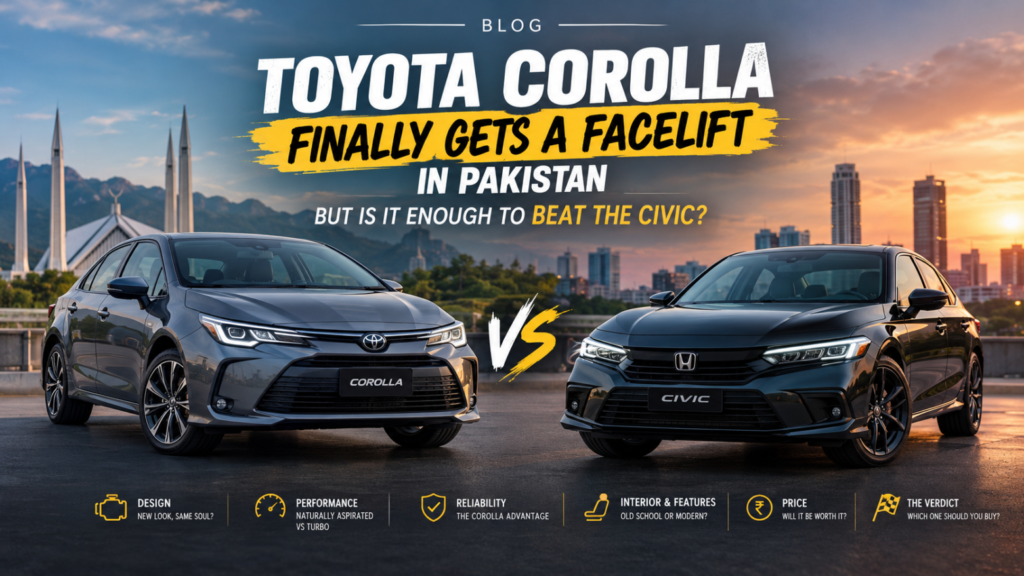
For years, one question has kept coming back whenever Pakistan’s automotive market is discussed:
“Corolla ka naya model kab aa raha hai?”
Well, Toyota has finally given us an answer—although perhaps not exactly the one everyone was waiting for.
The Toyota Corolla has finally received a facelift in Pakistan. The updated car brings a refreshed exterior, giving the familiar Corolla a more modern appearance without completely changing what sits underneath. And that is where things get interesting.
Because this isn’t an all-new Corolla. It is still fundamentally the same generation that Pakistani buyers have been driving for years. Toyota has essentially taken a familiar recipe, updated the styling, and given it another shot at competing in a market that has changed dramatically around it. The real question isn’t whether the new Corolla looks better. It does. The real question is whether a facelift is enough to keep the Corolla competitive against the Honda Civic—and increasingly, against a whole new generation of Chinese cars entering Pakistan.
A Much-Needed Fresh Face
Let’s start with the obvious. The old Corolla was beginning to look dated. There was nothing particularly wrong with its design, but when you park it next to newer cars, you can immediately see the difference in age. The facelift addresses that problem with a redesigned front end, updated headlights, a revised grille, and a sharper bumper. The rear has also received changes, giving the car a fresher appearance from almost every angle.
It isn’t a completely new design, but Toyota probably didn’t need to reinvent the Corolla. The basic shape still works. In fact, the facelift makes the Corolla look like what it should have looked like all along—a modern, mature sedan rather than an aging design that has simply refused to leave the market. But then you look at the Civic. And suddenly, the problem becomes obvious.
Corolla vs Civic: Which One Looks Better?
This is subjective, but the Civic still has the advantage. The current Civic has a more modern silhouette. It sits lower, looks wider, and has a design that immediately feels like it belongs to the current generation of cars. The facelifted Corolla, on the other hand, looks fresher but familiar. That’s not necessarily a bad thing. The Corolla is trying to appeal to a very different buyer. Its design isn’t supposed to scream performance or youth. It is supposed to look respectable, mature, and expensive enough to park outside an office or a house in a decent neighborhood. And it achieves that. But if we’re talking purely about design appeal, the Civic still wins.
The Bigger Problem Is Under the Bonnet
The Corolla has always been a sensible family sedan. It’s comfortable, spacious enough for a family, relatively easy to maintain, and well suited to Pakistan’s roads. The boot is generous, the driving position is familiar, and the suspension setup is designed more around comfort than aggressive driving. And honestly, that’s what most sedan buyers want. Not everyone wants to attack corners. Some people simply want to drive from Lahore to Islamabad with their family, stop for tea somewhere along the way, and come back home and not think about their car for the next six months.
For that buyer, the Corolla makes a lot of sense. The Civic is the more exciting car. The Corolla is the more conservative choice. And “conservative” isn’t necessarily a bad word when you’re spending millions of rupees.
But What About the Interior?
This is probably where Toyota has the most catching up to do. The facelift improves the overall appearance of the Corolla, but it doesn’t magically turn the cabin into a completely new-generation interior. The Civic feels more modern from the moment you sit inside it.Its dashboard design, technology, and overall cabin experience give you the feeling that you’re sitting inside a newer car.
The Corolla, meanwhile, feels like an evolution of something we’ve already known for years. And this is becoming a bigger issue because Pakistani buyers are no longer comparing Japanese cars only against each other. They’re looking at Chinese cars. And Chinese manufacturers have figured out one thing very quickly: People love features. Large screens, cameras, driver-assistance systems, digital displays, electronic features, and premium-looking interiors are becoming increasingly common. So Toyota can’t rely on the Corolla name forever. At some point, buyers are going to ask, “Agar itnay paisay dene hain, toh features kya mil rahe hain?”
The Price Will Decide Everything
This may ultimately be the most important part of the entire story. If Toyota keeps the facelift competitively priced, the Corolla can remain extremely relevant. But if the price climbs too close to the Civic, the decision becomes much more difficult. Imagine you’re sitting at a dealership with a substantial amount of money ready to spend. On one side you have the Corolla—proven reliability, excellent resale, easy maintenance, and a familiar ownership experience. On the other side you have the Civic—newer-feeling design, turbocharged performance, better driving dynamics, and a more modern overall package. At that point, the Corolla needs to make a very strong financial argument. Because if the difference becomes small enough, many buyers will simply say, “Civic le lo.” And that’s the danger Toyota faces.
So, Is the Corolla Better Than the Civic?
No. Not as an overall product. The Civic remains the more modern and exciting sedan. It feels newer. It drives better. Its powertrain is more contemporary, and its interior gives you a stronger sense that you’re buying a car designed for today’s market. But that doesn’t mean the Corolla has lost. Far from it. The Corolla is playing a different game. It’s the car for the buyer who values reliability over excitement, simplicity over complexity, and resale value over having the latest technology. And in Pakistan, those things still matter enormously.
The Real Winner Depends on What You Want
If you’re someone who enjoys driving, wants stronger performance, and cares about having a modern-looking car, the Civic is the obvious choice. But if you’re buying a car for the family, keeping it for years, travelling regularly, and want something that is easy to maintain and easy to sell later, the Corolla remains incredibly difficult to ignore. And that’s why Toyota doesn’t necessarily need to beat the Civic on every specification.
It just needs to remain the safe choice. The problem is that the definition of a safe choice is changing. Ten years ago, buying a Corolla was almost an automatic decision for many Pakistani families. Today, buyers have more options. The Civic is stronger. Chinese cars are getting better. Hybrids are becoming increasingly relevant. EVs are slowly entering the mainstream. And consumers are becoming much more demanding. So Toyota’s facelift isn’t just a design update. It’s a test. A test of whether the Corolla name still has enough power to compensate for an aging platform.
My Verdict
The facelift was absolutely necessary. It makes the Corolla look considerably fresher and gives the car another opportunity to compete in Pakistan’s increasingly crowded sedan market. But personally, I would still give the overall advantage to the Civic. Civic — 8.6/10 Corolla Facelift — 8.2/10
The Civic wins because it feels like the more modern product. The Corolla wins where Pakistan has traditionally loved it—reliability, practicality, resale, and peace of mind. And perhaps that’s the most interesting thing about this comparison. The Corolla doesn’t need to become a Civic. It simply needs to remain a Corolla—but a Corolla that finally feels like it belongs in 2026.
Because if Toyota has only changed the face of the car while keeping everything else almost exactly the same, then eventually Pakistani buyers are going to ask a very uncomfortable question:
“Bhai, facelift toh kar diya… lekin next-generation Corolla kab aa rahi hai?”


