
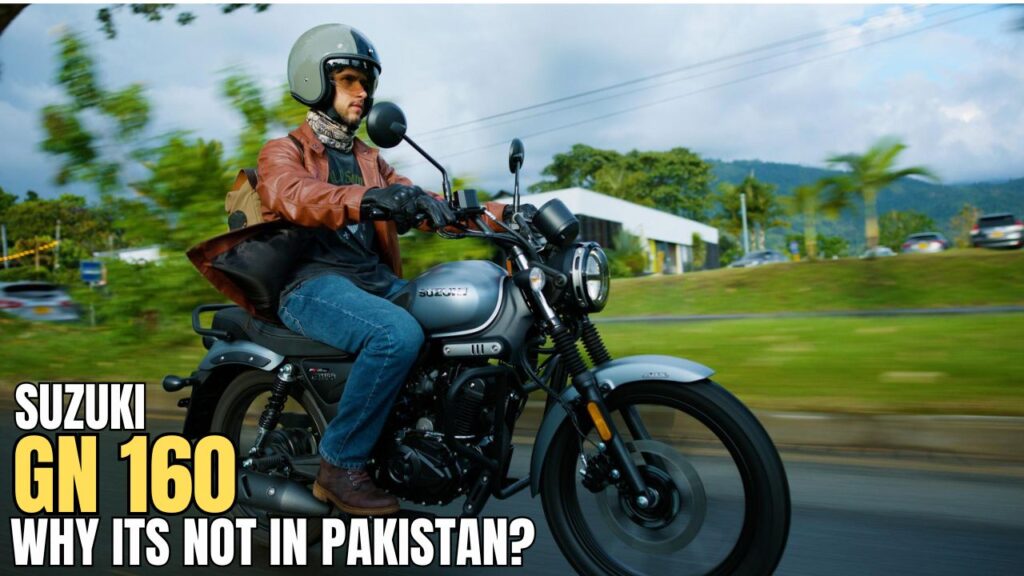
Suzuki GN160: The GS150 Replacement in Pakistan Is Still Waiting For
Suzuki has introduced the new GN160 in international markets, and naturally, the question for Pakistani motorcycle enthusiasts is, when will we get it?
For years, the Suzuki GS150 has occupied a unique position in Pakistan’s motorcycle market. It has been one of the most affordable ways to enter the 150cc category while offering a bigger, more comfortable, and more powerful alternative to traditional 70cc and 100cc motorcycles.
But the GS150 is also showing its age.
This is where the new Suzuki GN160 becomes particularly interesting. It follows a very similar basic formula to the GS150—a simple air-cooled single-cylinder engine, 5-speed transmission, conventional chassis, and 18-inch wheels—but adds the kind of technology we now expect from a modern motorcycle.
So why hasn’t Suzuki Pakistan brought it here?
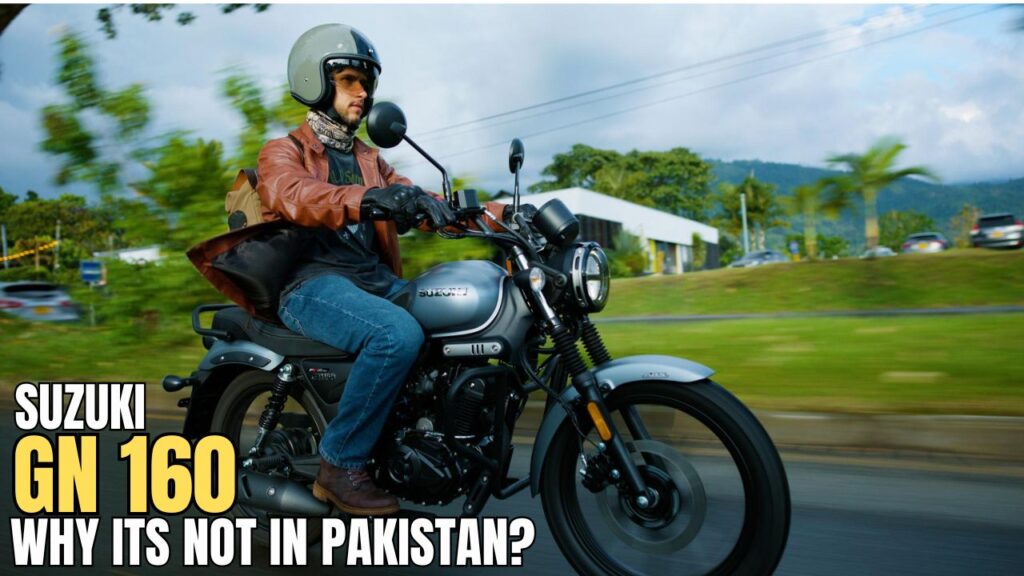
Why Isn’t the GN160 Coming to Pakistan?
The biggest reason could simply be the GS150 itself.
Suzuki Pakistan currently sells the GS150 at around Rs. 399,900, making it one of the most affordable Japanese-brand motorcycles in the 150cc category.
The GN160, on the other hand, is a considerably more modern motorcycle. It gets fuel injection, front ABS and a more powerful 162cc engine. Bringing this motorcycle to Pakistan would inevitably push its price considerably higher than the GS150.
And that creates a problem for Suzuki.
If Suzuki launches the GN160 at Rs. 500,000 or more, it immediately enters a much more competitive price bracket. If it keeps the price close to the GS150, Suzuki would have to accept a much smaller margin or invest heavily in local production and sourcing.
There is another possibility: Suzuki simply doesn’t want to disrupt its existing motorcycle business.
The GS150 is an old platform, but it is familiar, established, and relatively inexpensive to manufacture. A new model means new tooling, components, supply chains, training, and marketing.
From a business perspective, replacing a motorcycle that is still selling with a more expensive model is not an easy decision.
What Exactly Is the Suzuki GN160?
The GN160 is essentially Suzuki’s modern interpretation of the traditional standard motorcycle.
It uses a 162cc, single-cylinder, air-cooled, SOHC, 2-valve engine with fuel injection.
The engine produces approximately:
14.3 hp at 8,000 rpm
and
14.5 Nm of torque at 6,500 rpm.
Power is sent through a 5-speed manual gearbox.
On paper, those numbers may not sound revolutionary, but they are significant when compared with the old-school GS150 formula.
The GN160 also gets front-wheel ABS, something completely absent from the GS150.
The rear brake remains a drum, keeping the motorcycle relatively simple and practical.
The motorcycle uses conventional telescopic front suspension and adjustable twin rear shocks, while 18-inch wheels maintain the traditional standard-bike riding characteristics.
In other words, Suzuki hasn’t tried to turn the GN160 into a racing motorcycle.
It is still a practical everyday motorcycle — just a much more modern one.
GN160 vs GS150
Here is where things get interesting.
| Specification | Suzuki GS150 | Suzuki GN160 |
|---|---|---|
| Engine | 150cc | 162cc |
| Engine Type | Air-cooled, SOHC | Air-cooled, SOHC |
| Valves | 2 | 2 |
| Fuel System | Carburetor | Fuel Injection |
| Maximum Power | Approx. 12 hp class | 14.3 hp |
| Maximum Torque | Approx. 12 Nm class | 14.5 Nm |
| Transmission | 5-speed | 5-speed |
| Front Brake | Drum | Disc + ABS |
| Rear Brake | Drum | Drum |
| Front Suspension | Telescopic | Telescopic |
| Rear Suspension | Twin Shock | Adjustable Twin Shock |
| Front Wheel | 18-inch | 18-inch |
| Rear Wheel | 18-inch | 18-inch |
| Fuel Tank | 13 litres | 11 litres |
| Weight | 118 kg | Approx. 128 kg |
| Fuel System Technology | Carburetor | EFI |
The numbers tell an interesting story.
The GN160 is not dramatically larger than the GS150, but it is clearly more modern.
The biggest upgrades aren’t actually the extra 12cc.
They are fuel injection, ABS, stronger torque output and newer chassis/electrical technology.
How Would the GN160 Feel on Pakistani Roads?
We think this is where the GN160 could make the biggest impression.
The GS150 has always been appreciated for its comfortable riding position and relatively relaxed character. The GN160 keeps that basic philosophy.
The additional torque should make it feel stronger when accelerating from low and mid-range speeds, while the fuel injection should provide more consistent throttle response than the GS150’s carburetor.
The extra weight is worth mentioning, though.
At around 128 kg, the GN160 is roughly 10 kg heavier than the 118 kg GS150. That means it won’t necessarily feel dramatically faster simply because it produces more horsepower.
However, that additional weight could also contribute to a more planted feeling at higher speeds.
The 18-inch wheels are another positive for Pakistan. They maintain the traditional motorcycle setup that works well on our roads and provide a familiar riding character for existing GS150 owners.
The Biggest Upgrade: ABS
Perhaps the most important difference is the front ABS.
The GS150 uses drum brakes at both ends, while the GN160 brings a front disc with ABS.
For a motorcycle that could potentially be used for highway riding, touring and everyday urban commuting, this is a major safety upgrade.
It also gives the GN160 a much more modern specification sheet.
And this is exactly where the GS150 starts to look dated.
What Could the GN160 Cost in Pakistan?
This is obviously speculation because Suzuki Pakistan has not officially announced a Pakistani launch or price for the GN160.
But based on its specifications and Suzuki Pakistan’s existing lineup, we can make an educated estimate.
The current GS150 sits around Rs. 399,900, while Suzuki’s more expensive 150cc models are considerably higher.
If Suzuki Pakistan were to introduce the GN160 as a locally assembled motorcycle, we would expect a price somewhere around:
Rs. 500,000 – Rs. 550,000
Our ideal price would be approximately Rs. 525,000.
At that price, the GN160 would offer a meaningful upgrade over the GS150 without moving too close to the premium end of the 150cc market.
However, if Suzuki prices it above Rs. 550,000, things become considerably more complicated.
At that point, buyers will start looking at the company’s own GR150 as well as several Chinese motorcycles offering larger engines and more equipment.
What Would Happen to the GS150?
This is probably the most interesting question.
If Suzuki Pakistan actually launches the GN160, we see three possible scenarios.
1. The GN160 Replaces the GS150
This would be the cleanest solution.
Suzuki could gradually phase out the GS150 and introduce the GN160 as its new mainstream 150/160cc motorcycle.
The message would be simple:
GS150 → GN160
The customer gets more power, fuel injection, ABS and a modern platform.
2. Both Bikes Continue
Suzuki could also keep the GS150 as its entry-level 150cc motorcycle and position the GN160 as a premium alternative.
For example:
GS150 — around Rs. 400,000
GN160 — around Rs. 525,000
This would allow Suzuki to retain customers who want a simple and affordable motorcycle while attracting buyers looking for modern features.
But the price difference would be substantial.
3. The GN160 Never Comes
Unfortunately, this may be the most realistic scenario in the short term.
Suzuki Pakistan has historically been conservative when it comes to updating its motorcycle portfolio.
The GS150 remains relatively inexpensive and has a strong reputation. From Suzuki’s perspective, there may simply not be enough commercial pressure to replace it.
But the longer Suzuki waits, the more difficult the GS150’s position becomes.
Would the GN160 Kill the GS150?
Not immediately.
The GS150 has several advantages.
It is lighter, cheaper, mechanically simple and has a 13-litre fuel tank. Its long-established reputation also means buyers already know what they are getting.
The GN160, however, would make the GS150 look considerably older.
Imagine walking into a Suzuki dealership and seeing these two motorcycles side by side.
One has:
Carburetor + drum brakes + 150cc
while the other has:
Fuel injection + ABS + 162cc + 14.3 hp + 14.5 Nm.
For many buyers, the decision would be obvious — provided they can afford the price difference.
The Real Problem Isn’t the GN160
The GN160 itself isn’t the problem.
The problem is that the GS150 has remained almost unchanged while the rest of the motorcycle market has moved forward.
Chinese manufacturers are increasingly offering fuel injection, LED lighting, digital instrumentation, disc brakes, ABS and larger engines.
Even if the GN160 isn’t the most technologically advanced 160cc motorcycle available globally, it would still represent a massive step forward for Suzuki’s mainstream motorcycle offering in Pakistan.
And that’s why we believe the GN160 would make more sense in Pakistan than many of the flashy motorcycles currently being imported.
It is simple.
It is practical.
It has 18-inch wheels.
It has a relatively uncomplicated air-cooled engine.
It has fuel injection.
It has ABS.
And it retains the classic standard-bike design that Pakistani riders have traditionally preferred.
Final Verdict
The Suzuki GN160 could be exactly what Suzuki Pakistan needs — a modern successor to the GS150 without abandoning the basic formula that made the GS150 popular in the first place.
We don’t need Suzuki to bring a 200cc sports bike or a complicated liquid-cooled machine.
We need something like the GN160.
A simple, reliable, comfortable motorcycle with modern safety and fuel-management technology.
If Suzuki Pakistan can bring the GN160 here at around Rs. 500,000–525,000, we believe it could become one of the most interesting Japanese motorcycles in Pakistan’s 150/160cc segment.
But there is one big question Suzuki Pakistan needs to answer:
Is it finally time to retire the GS150 and give Pakistan a proper successor?
Because if the GN160 ever arrives, the GS150 won’t necessarily become a bad motorcycle.
It will simply become what it already looks like today:
a very good motorcycle from another era.


