
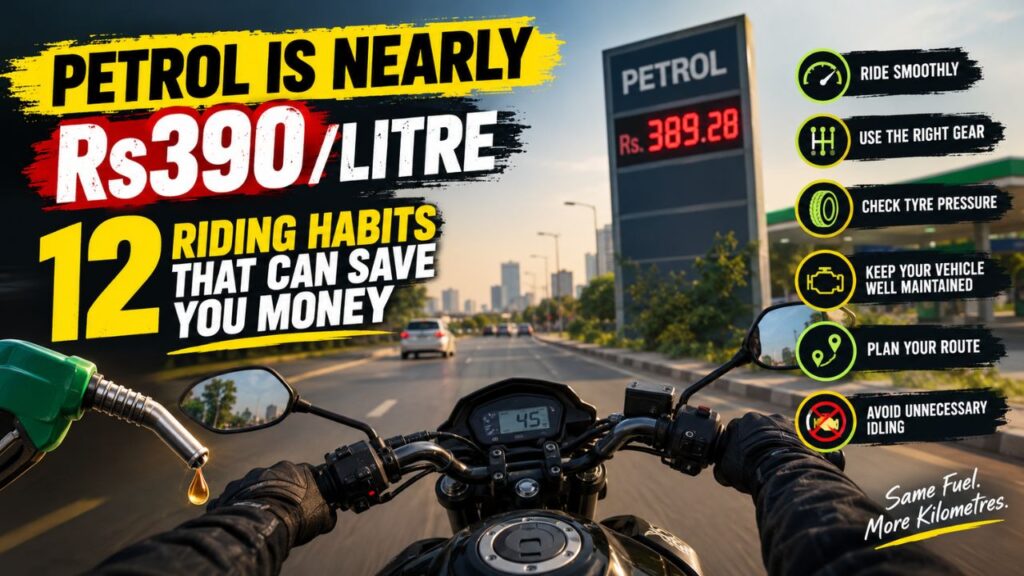
Petrol prices in Pakistan have reached a level where every extra kilometer per liter matters.
As of September 24, petrol was priced at around Rs389 per liter, making fuel one of the biggest running costs for anyone who commutes daily by motorcycle or car.
But while we cannot control the international oil market, taxes, or petrol prices, there is one thing we can control:
How we ride and drive.
You don’t necessarily need a new motorcycle, expensive modifications, or an aftermarket fuel-saving device. In many cases, simply changing your riding habits can improve fuel economy.
Here are some practical things an ordinary Pakistani rider or driver can do.
1. Stop Treating Every Traffic Signal Like a Drag Race
One of the easiest ways to waste petrol is aggressive acceleration.
You stop at a signal, the light turns green and suddenly everyone wants to reach 60 km/h before the person next to them.
Hard acceleration means the engine has to burn more fuel to produce power quickly. The same applies to cars and motorcycles.
Instead, accelerate progressively.
You don’t have to crawl away from every signal. Just avoid unnecessarily opening the throttle completely every time you move.
Research from the US Department of Energy indicates that aggressive driving involving rapid acceleration, speeding and hard braking can reduce fuel economy substantially—by roughly 10–40% in stop-and-go traffic and 15–30% at highway speeds.
The simple rule:
Smooth acceleration > aggressive acceleration.
You will probably notice the difference in your average fuel consumption over several tanks.
2. Stop Braking Hard for Things You Could See Coming
This is where riding style makes a surprisingly big difference.
Imagine you’re approaching a red light.
You are doing 50 km/h, continue accelerating until you’re close to the signal and then suddenly hit the brakes.
You’ve just used fuel to gain speed that you immediately threw away as heat through your brakes.
Instead, look ahead.
If the traffic light is red, ease off the throttle earlier and allow the motorcycle or car to slow naturally where appropriate.
The same applies when approaching:
- Traffic jams
- Speed breakers
- Turns
- Toll plazas
- Intersections
- Slow-moving traffic
The goal isn’t to drive dangerously slowly. The goal is to anticipate traffic instead of constantly going from accelerator to brake and back again.
3. Don’t Ride at Full Throttle Just Because the Road Is Empty
An empty road can be dangerous for your fuel economy.
Once traffic disappears, many riders instinctively increase their speed.
The problem is that aerodynamic drag increases rapidly with speed, meaning maintaining a much higher speed requires considerably more energy.
So if your usual commute allows you to maintain a moderate, steady speed, you will generally use less fuel than if you constantly ride aggressively at high speed.
This is particularly relevant on motorcycles because riders often have a tendency to keep accelerating simply because the road ahead is clear.
Fast doesn’t always mean efficient.
4. Learn to Use the Throttle Properly
This sounds obvious, but throttle control is one of the biggest differences between an experienced economical rider and someone who rides aggressively.
Instead of constantly moving between:
0% → 100% → 0% throttle
try to maintain a smooth throttle input whenever traffic conditions allow.
On a motorcycle, this also means learning the relationship between:
- Throttle position
- Engine RPM
- Gear selection
- Road speed
If you’re in too high a gear and the engine is struggling, don’t force it.
If you’re unnecessarily revving the engine in a low gear, shift appropriately.
The objective isn’t to ride at the lowest possible RPM at all times. The objective is to keep the engine operating comfortably without unnecessary revving.
5. Don’t Keep the Engine Idling for No Reason
This is one of the most common fuel-wasting habits.
You stop outside a shop.
You wait for someone.
You are parked outside an office.
You are sitting in a parking area talking to someone.
And the engine is running the entire time.
The vehicle is consuming fuel while travelling zero kilometres.
The US Department of Energy specifically identifies unnecessary idling as a fuel-wasting habit. In some conditions, idling can consume roughly a quarter to half a gallon of fuel per hour depending on the engine and accessories.
For Pakistani riders, this is especially relevant during roadside stops.
If you know you’re going to be stationary for a meaningful amount of time, switch the engine off when it is safe and practical to do so.
Obviously, don’t blindly apply this rule in every situation. Traffic, safety, extreme heat and the requirements of the vehicle all matter.
But leaving an engine running simply because you’re too lazy to switch it off?
That’s literally burning money while standing still.
6. Check Your Tyre Pressure
Your tyres are the only part of your motorcycle or car actually touching the road.
If they aren’t maintained properly, you’re making the engine work harder.
Under-inflated tyres increase rolling resistance and can reduce fuel economy. The US Department of Energy says maintaining recommended tyre pressure can improve fuel economy by around 0.6% on average and potentially up to 3%.
For motorcycles, check the manufacturer’s recommended pressure rather than simply copying a number from another bike.
And don’t assume:
“Thora pressure kam hai, koi masla nahi.”
It can affect handling, tyre wear and fuel consumption.
Make tyre pressure checking part of your routine.
7. Don’t Carry Half Your House on Your Vehicle
This is particularly relevant to cars.
Extra weight means the engine has to move more mass every time you accelerate.
Remove things you don’t actually need.
Old tools, unnecessary luggage, boxes, spare equipment and other junk sitting permanently in the boot may not seem important individually, but carrying unnecessary weight everywhere makes little sense.
The Department of Energy notes that extra vehicle weight can reduce fuel economy, with smaller vehicles generally being more affected.
For motorcycles, the same basic principle applies.
You don’t need a massive luggage setup for a five-kilometre office commute.
8. Maintain the Vehicle Instead of Blaming the Petrol
Sometimes the problem isn’t your riding style.
It’s the motorcycle or car.
A poorly maintained engine can consume more fuel than it should.
Regularly pay attention to:
- Engine oil
- Air filter
- Spark plug
- Tyre pressure
- Chain condition and lubrication on motorcycles
- Brake drag
- Fuel-system condition
- Correct engine oil grade
- Wheel alignment where applicable
A motorcycle with a tight or poorly lubricated chain, dragging brakes or severely under-inflated tyres is not going to deliver the same economy as a properly maintained motorcycle.
The Department of Energy also recommends proper maintenance and the manufacturer’s recommended motor oil grade as part of improving fuel economy.
9. Combine Your Trips
This is something most people don’t think about.
Suppose you need to:
- Go to the market
- Visit the bank
- Pick something up
- Buy groceries
Instead of making four separate trips throughout the day, plan them together when possible.
One properly planned trip can be significantly more efficient than repeatedly starting the vehicle and covering the same roads multiple times.
The US Department of Energy specifically recommends combining errands to reduce total driving distance.
And in Pakistan, where traffic congestion can turn a short trip into a fuel-consuming exercise, route planning can make an even bigger difference.
10. Choose Your Route, Not Just Your Destination
Google Maps or another navigation app isn’t only useful for finding the destination.
It can help you understand traffic and choose a route that avoids unnecessary congestion.
A route that is two kilometres longer but keeps you moving smoothly may sometimes consume less fuel than a shorter route where you’re stuck in stop-start traffic for 30 minutes.
The most fuel-efficient route isn’t always the shortest route.
Sometimes it’s the route with less unnecessary stopping and accelerating.
11. Don’t Ride in the Wrong Gear
For motorcycles with manual transmissions, gear selection matters.
Riding continuously in a very low gear at high RPM can waste fuel.
But there is another extreme too: putting the bike into a very high gear at an unnecessarily low speed and forcing the engine to struggle.
The sweet spot varies between motorcycles.
A 70cc commuter, 125cc motorcycle, 150cc bike and 250cc adventure motorcycle will all have different gearing and ideal operating characteristics.
So instead of blindly following:
“4th gear mein chalao, petrol bachega.”
Learn how your particular motorcycle behaves.
Smooth engine operation is more important than following an arbitrary RPM or gear rule.
12. Don’t Expect Fuel-Saving Tricks to Perform Miracles
Pakistan’s market is full of claims about devices, magnets, additives and modifications that supposedly transform fuel economy.
Be skeptical.
If someone claims a Rs2,000 gadget will suddenly turn your motorcycle from 35 km/l to 60 km/l, ask for proper evidence.
There is no magic button.
The biggest improvements for most everyday riders come from the boring stuff:
Better riding + proper maintenance + correct tyre pressure + less unnecessary idling + sensible routes.
Those habits don’t look exciting on Instagram, but they can actually save money.
So, How Much Can You Actually Save?
Let’s take a simple example.
Suppose your motorcycle normally gives:
40 km/l
and you ride approximately:
1,000 km per month.
At 40 km/l, you need around:
25 litres of petrol.
At roughly Rs389 per litre, that is approximately:
Rs9,725 per month.
Now imagine you improve your riding and maintenance enough to reach:
45 km/l.
Your fuel requirement drops to around:
22.2 litres.
That’s roughly 2.8 litres less petrol every month for the same 1,000 km.
At Rs389/litre, that’s approximately:
Rs1,100 saved per month.
Over a year, that’s roughly:
Rs13,000.
And that’s from a relatively small improvement.
Your actual savings will depend on your motorcycle, traffic, riding style, distance and petrol price, but the principle is simple:
Every extra kilometre you get from every litre is money staying in your pocket.
The Biggest Petrol-Saving Habit: Change Your Mindset
You don’t need to ride like a snail.
You don’t need to switch your bike off at every traffic signal.
You don’t need to remove your air conditioner.
And you certainly don’t need to spend money on every “fuel-saving” product advertised online.
Instead, become a smoother rider.
Look further ahead.
Accelerate progressively.
Brake less aggressively.
Avoid unnecessary idling.
Maintain your motorcycle or car.
Keep your tyres at the recommended pressure.
Plan your trips.
And don’t use the throttle simply because the road ahead is empty.
At today’s petrol prices, fuel economy isn’t just a technical specification anymore—it’s a financial habit.
You can’t decide what petrol will cost next month.
But you can decide how much petrol your vehicle wastes.


